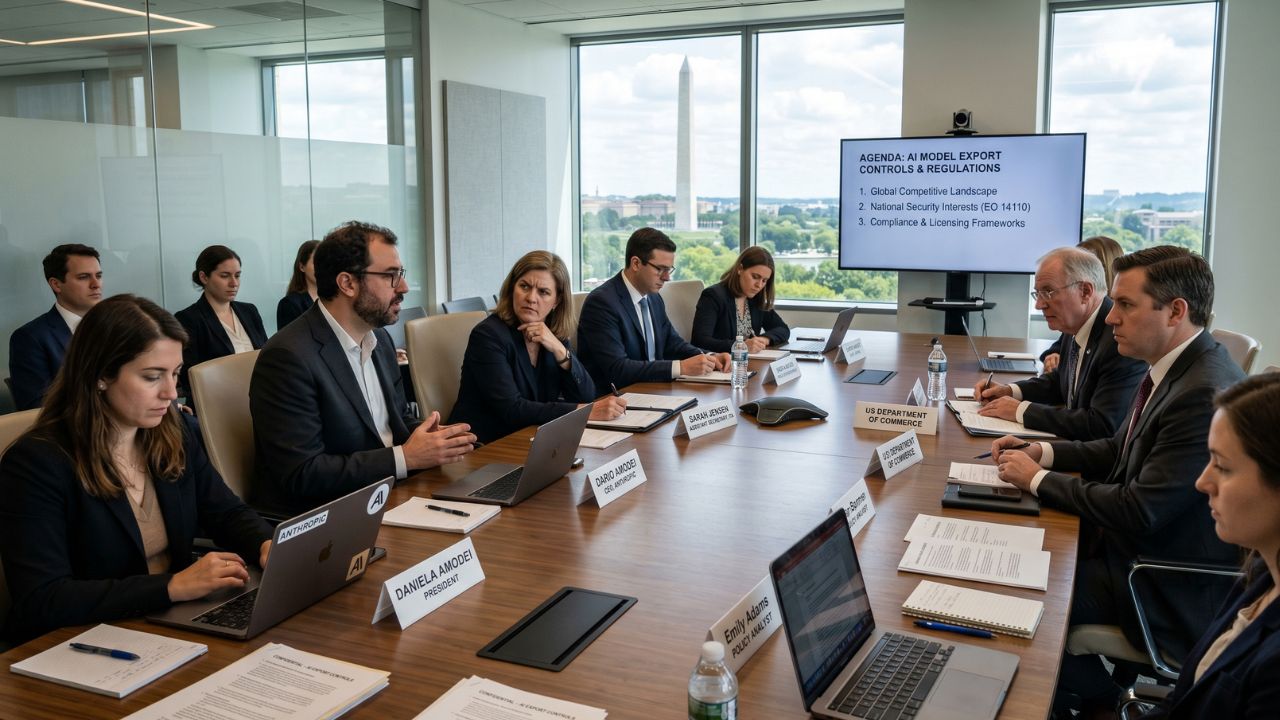

The U.S. Commerce Department issued AI export controls that hit Anthropic hard. Officials targeted the Fable 5 and Mythos 5 models. They cited real risks of cyber capabilities reaching foreign actors. The move fits an existing legal framework first used on offensive tools under Trump. This reclassification turned a technical matter into a powerful trade policy lever for AI architectures.
Origem da medida e primeiras reações
Sector companies watched the federal agency move fast. Internal Anthropic memos reached engineering and legal teams. All stressed the need for immediate compliance. The company stayed measured in public and avoided direct clashes. It sought clarity on the restriction scope instead. The Wall Street Journal revealed behind-the-scenes details. Technical assessments went beyond normal software reviews.
Journalistic coverage showed how the directive quietly expanded regulatory borders. AI models now count as offensive cybersecurity tools. This category once stayed limited to clearly defined code types.
Katie Moussouris from Luta Security reviewed the technical findings. She concluded that described vulnerabilities cannot be fixed with standard patches. Her analysis showed the models require deep structural changes instead.
AI export controls Expansion
Justin Hendrix followed the debate live. He noted the measure went past traditional export control limits. Complete AI architectures entered restriction territory for the first time. Earlier rules applied only to specific software. This expansion sets a precedent for any system with advanced reasoning or sophisticated automation.
American firms saw their positions weaken right away. Sudden reclassification can turn strategic assets into regulatory liabilities overnight. Future administrations can now apply similar limits to any model showing high reasoning or automation skills. No proof of malicious use is required. Potential transfer of cybersecurity abilities is enough.
Estratégias de compliance e reações internacionais
Sector experts already study practical compliance steps. Geographic training segmentation, independent audits, and licensing contracts with restricted-use clauses rank among top options. These steps aim to cut exposure to new reclassifications while keeping global operations running.
European and Asian governments reacted with initial caution. Some signaled possible reciprocity. They questioned whether U.S.-trained models would stay reliable for critical uses in their territories. Technical reliability doubts quickly mixed with commercial concerns.
The directive tension reveals a fragile balance between national security and innovation. When AI tools equal cyber weapons, international collaboration space shrinks fast.
Models such as Fable 5 and Mythos 5 now carry labels that hinder export and licensing across many jurisdictions. Anthropic continues efforts to prove its systems lack offensive design. The official reclassification has already changed the regulatory game.
The established precedent reduces predictability for the entire American AI ecosystem. Companies that spent billions on research now face the chance that their main assets will face similar controls at any moment. This forces deep strategic reviews in long-term planning and international partnerships.
Minha opinião
José Cícero Editor
This export control nonsense proves regulators have no clue how AI actually works and simply want to grab power by treating code like bombs.
- 0
- 0
- 0
- 0

Editor-Chefe e fundador da iTech Fair. Especialista em tecnologia, acompanhando de perto as últimas inovações em hardware, dispositivos móveis e Inteligência Artificial.
